


Since 2012 – Quality Wholesale Parts, Nationwide! Connect With Us Now
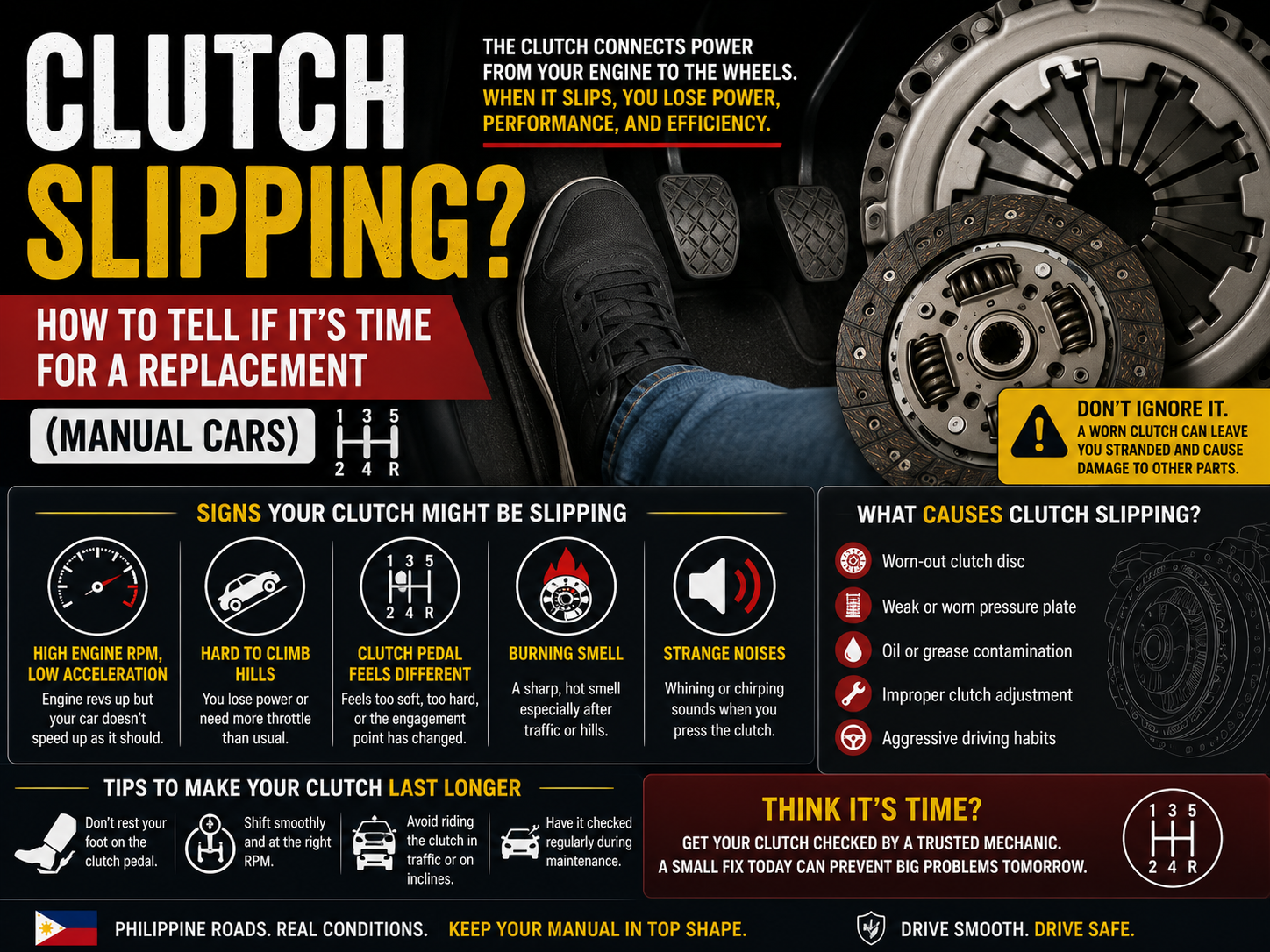
Is your car’s clutch feeling “soft” or slipping when you try to accelerate? In the Philippines’ challenging driving conditions—from Manila’s notorious stop-and-go traffic to steep hill starts in Baguio or Tagaytay—your clutch takes a real beating. With over 12.4 million registered vehicles nationwide and countless manual transmission vehicles navigating our congested streets, clutch wear is a common but often misunderstood issue.
Recognizing the early signs of clutch wear can save you from getting stranded on EDSA during rush hour or facing a more expensive repair down the road. This guide will help you identify clutch slipping symptoms specific to Philippine driving conditions, understand when it’s time for a replacement, and make informed decisions about your vehicle’s maintenance. Whether you drive a Toyota Vios, Honda Civic, Mitsubishi L300, or Ford Ranger, knowing these warning signs will keep you safely on the road and potentially save thousands in unnecessary repairs.
The most obvious sign of a slipping clutch is engine acceleration without corresponding vehicle acceleration. When you press the accelerator, the engine RPMs climb rapidly, but your car doesn’t gain speed as expected—especially noticeable when trying to overtake on highways like NLEX or SCTEX, or when climbing steep inclines like Kennon Road.
Other key symptoms include:
In Philippine conditions, these symptoms often appear sooner due to our unique driving patterns. The constant stop-and-go traffic in cities like Manila, Cebu, and Davao means your clutch is engaging and disengaging hundreds of times daily—far more than in less congested environments.
Several Philippines-specific factors contribute to accelerated clutch wear:
Traffic Congestion: The average speed in Metro Manila during peak hours is just 15-20 km/h, according to MMDA data. This means constant clutch engagement for creeping forward in traffic—each stop requires pressing the clutch to shift to first gear, then releasing it to move forward a few meters before stopping again.
Hilly Terrain: Cities like Baguio, Tagaytay, and parts of Cebu and Davao require frequent hill starts. Holding a vehicle on an incline using the clutch (rather than the handbrake) generates tremendous heat and friction, wearing the clutch plate prematurely.
Hot Climate: Our average year-round temperature of 28°C with 80% humidity means under-hood temperatures can exceed 60°C. Heat accelerates wear on clutch friction materials and can cause hydraulic fluid to break down faster.
Overloading: Common with jeepneys, delivery vehicles, and even personal vehicles used for “pasalubong” runs, overloading puts excessive strain on the clutch assembly every time you move from a stop.
Poor Road Conditions: Potholes and uneven surfaces force frequent gear changes, increasing clutch usage beyond normal highway driving.
Understanding these factors explains why Filipino manual transmission drivers often need clutch service sooner than the 80,000-100,000 km interval suggested in many owner’s manuals—severe service conditions in the Philippines may warrant inspection as early as 40,000-60,000 km.
You don’t need special tools to perform a basic clutch check. Try these simple tests in a safe, empty parking lot:
The Highway Test: On an expressway like SCTEX or NLEX, accelerate to 80 km/h in 4th gear, then press the accelerator firmly. If the engine RPMs spike quickly but your speed doesn’t increase proportionally, your clutch is likely slipping.
The Hill Start Test: Find a safe incline (like those in Bonifacio Global City or Quezon City Circle). Stop completely, then try to start moving uphill without rolling back. If you need to give excessive throttle to prevent stalling or notice a burning smell, your clutch is worn.
The Parking Lot Test: In an empty parking lot, start in first gear and slowly release the clutch without pressing the accelerator. Note where the clutch begins to engage (the “bite point”). If this point is very high (near the top of pedal travel) or very low (near the floor), it indicates wear. A healthy clutch typically engages in the middle third of pedal travel.
Listen and Smell: After driving in heavy traffic, park and listen for any unusual squeaking or grinding when pressing the clutch. Sniff around the clutch pedal area for that distinctive burning odor—especially noticeable after attempting a steep hill start.
While minor clutch wear can sometimes be managed with adjusted driving habits, these symptoms indicate replacement is urgently needed:
In the Philippine context, consider proactive replacement if you regularly drive in severe conditions and have exceeded 50,000 km on your original clutch, even without severe symptoms. Preventive replacement during routine maintenance can save you from emergency repairs and towing costs.
Understanding potential costs helps you budget appropriately and avoid surprise expenses:
Labor Costs:
– Independent garages: ₱1,200 – ₱2,500
– Dealership service centers: ₱2,500 – ₱4,000
– Specialized transmission shops: ₱2,000 – ₱3,500
Parts Costs (clutch kit: disc, pressure plate, release bearing):
– Japanese sedans (Toyota/Honda/Nissan): ₱2,500 – ₱4,500
– Korean models (Hyundai/Kia): ₱2,000 – ₱4,000
– European vehicles: ₱4,000 – ₱7,000+
– Pickup trucks/SUVs: ₱3,500 – ₱6,000
Total Typical Range: ₱4,000 – ₱8,000 for most passenger vehicles
High-End/Luxury Vehicles: ₱8,000 – ₱15,000+
Commercial Vehicles: ₱5,000 – ₱10,000+ (due to heavier-duty components)
Money-Saving Tips:
1. Ask if your mechanic can resurface the flywheel instead of replacing it (if it’s not severely damaged)
2. Consider OEM-quality aftermarket parts from trusted brands like LuK, Sachs, or Valeo
3. Replace the clutch slave cylinder and master cylinder while the transmission is out—it saves labor costs later
4. Get multiple quotes, but beware of prices that seem too good to be true—quality clutch work requires expertise
Pro Tip: Many Filipino mechanics recommend replacing the clutch as a complete kit rather than piecemeal. While the initial cost is higher, it prevents having to pay for the same labor again soon if related components fail shortly after.
Not all clutch kits are created equal, especially when considering our unique driving environment:
OEM vs Aftermarket:
– OEM parts guarantee exact fit and factory-spec performance
– Quality aftermarket brands often provide better heat resistance and durability for severe service
– Avoid ultra-cheap “no-name” brands—they often wear out faster than the original
Material Considerations:
– Organic: Smooth engagement, good for daily driving but wears faster in stop-and-go traffic
– Ceramic/Metallic: Higher heat tolerance, better for performance or heavy loads—but can be harsh in traffic
– Kevlar: Excellent balance of durability and smooth engagement—ideal for Philippine conditions
Climate Adaptation: Look for kits specifically designed for high-temperature environments. Some aftermarket manufacturers offer “tropical climate” variants with heat-resistant friction materials.
Driving Style Match:
– City commuters: Prioritize smooth engagement and heat resistance
– Performance enthusiasts: Look for higher torque capacity
– Off-road/adventure vehicles: Focus on durability and mud/water resistance
When consulting with your mechanic about your specific driving patterns (daily EDSA commute vs. weekend provincial trips) will help them recommend the optimal clutch kit for your needs and budget.
While some wear is inevitable, these practices can significantly extend your clutch’s service life:
Driving Techniques:
– Don’t ride the clutch: Resting your foot on the pedal while driving causes constant friction and heat
– Use neutral at stops: In long traffic jams (like EDSA during rush hour), shift to neutral and release the clutch
– Hill starts: Use your handbrake on inclines, then release it as you engage the clutch—don’t “ride” the clutch to hold position
– Smooth acceleration: Avoid jackrabbit starts; gradual acceleration reduces clutch slippage
– Match RPMs when downshifting: Prevents abrupt engagement that wears clutch surfaces
Maintenance Practices:
– Check hydraulic fluid: Low or dirty clutch fluid affects engagement—check during oil changes
– Listen for changes: Note any differences in pedal feel or engagement point
– Address oil leaks: Engine oil leaking onto the clutch disc causes premature failure
– premature failure
Load Management:
– Respect weight limits: Overloading dramatically increases clutch strain
– Distribute cargo evenly: Uneven loads create inconsistent clutch engagement
– Use lower gears wisely: When carrying heavy loads, use appropriate gears to prevent lugging the engine
In our challenging driving environment, extending clutch life by even 20,000 km can save thousands of pesos over your vehicle’s lifetime. These habits pay off doubly by improving fuel efficiency and reducing stress on other transmission components.
Not all mechanics have equal expertise with clutch systems—especially important for modern dual-mass flywheel systems:
Look for Specialization:
– Shops that advertise transmission or clutch specialization
– Mechanics with specific training on your vehicle’s make/model
– Establishments that use torque wrenches for proper pressure plate bolt tightening
Questions to Ask:
– “How many clutch replacements do you perform monthly on vehicles like mine?”
– “Do you resurface or replace the flywheel as needed?”
– “What brands of clutch kits do you typically use and why?”
– “Do you replace the pilot bearing/bushing as part of the job?”
– “What warranty do you offer on parts and labor?”
Red Flags:
– Quotes significantly below market rate without clear explanation
– Unwillingness to show you the old parts after replacement
– Lack of clean, organized workspace (indicates poor attention to detail)
– Pressure to approve additional, unrelated repairs
Recommended Approach:
1. Start with your dealership for the first replacement (establishes baseline)
2. Ask for recommendations from enthusiast clubs (Toyota Owners Club Philippines, Honda Civic PH, etc.)
3. Try a reputable independent shop for subsequent services once you’ve established trust
4. Always request to see the worn components—reputable shops have no issue showing you what was replaced
Remember: A properly installed clutch should last 50,000-80,000 km under normal Philippine driving conditions. If yours fails significantly sooner, investigate potential installation issues or underlying problems like engine oil leaks or driving habits.
Understanding your clutch’s warning signs isn’t just about avoiding inconvenience—it’s about safety, savings, and confident driving in our uniquely challenging Philippine environment. From the stop-and-go grind of EDSA to the steep climbs of Marcos Highway, your clutch endures stresses that would shock drivers in more temperate climates.
By recognizing symptoms early—whether it’s that telltale engine rev without acceleration, a changing clutch pedal feel, or the unmistakable smell of burnt clutch material—you can address issues before they leave you stranded or cause collateral damage to your transmission. Remember that preventive maintenance and mindful driving habits in our heavy traffic conditions can extend clutch life significantly, saving you thousands over your vehicle’s lifespan.
When replacement becomes necessary, choose quality parts suited to our tropical climate and driving patterns, and seek experienced mechanics who understand the specific demands Philippine roads place on clutch systems. Your clutch is the vital link between engine power and forward motion—treat it with the respect it deserves, and it will serve you reliably through countless Philippine journeys.
Remember: A well-maintained clutch doesn’t just save you money—it gives you the confidence to tackle Manila’s traffic, conquer mountain passes, and enjoy the freedom of manual transmission driving without worrying about getting stranded. For all your clutch and automotive parts needs, visit KG CAR PH for expert advice and quality products.
Under normal mixed driving, expect 50,000-80,000 km. In severe Manila traffic or frequent hill driving, 30,000-50,000 km is more realistic. Aggressive driving or overloading can reduce this to under 20,000 km.
It’s not recommended. Continued driving increases heat and wear, potentially damaging the flywheel or pressure plate—turning a clutch replacement into a much more expensive repair. If you must drive, keep trips short and avoid hills or heavy loads.
Typically no, as clutch wear is considered a “wear and tear” item like brake pads or tires. However, if failure occurs unusually early (under 20,000 km) and you can prove it’s not due to driving habits, some manufacturers may consider it a defect.
Only if it shows signs of heat checking, cracking, or deep grooves. A mechanic can resurface a slightly worn flywheel, but replacement is necessary for significant damage. Always have it inspected during clutch service.
If the pedal feels spongy, sinks to the floor, or requires pumping to build pressure, you likely have air in the system or a failing master/slave cylinder. Low or contaminated fluid in the reservoir is another clear indicator.
Generally no for typical passenger vehicles. Ceramic clutch’s aggressive engagement can be jerky in traffic and may wear other components faster. Organic or Kevlar-containing kits usually provide better streetability for Philippine conditions while still offering good durability.
Since 2012, KG Car PH has been the go-to for affordable car parts in the Philippines. We make it easy to find the right fit and offer same-day delivery nationwide—so you get quality parts fast, without spending more.
SOCIAL MEDIA
TOP CATEGORIES
QUICK LINKS
HELP
support@kgcar.ph
© 2026 KGCAR.PH
Since 2012, KG Car PH has been the go-to for affordable car parts in the Philippines. We make it easy to find the right fit and offer same-day delivery nationwide.
Enter your email or mobile so we can follow up with answers, quotes & deals.