


Since 2012 – Quality Wholesale Parts, Nationwide! Connect With Us Now
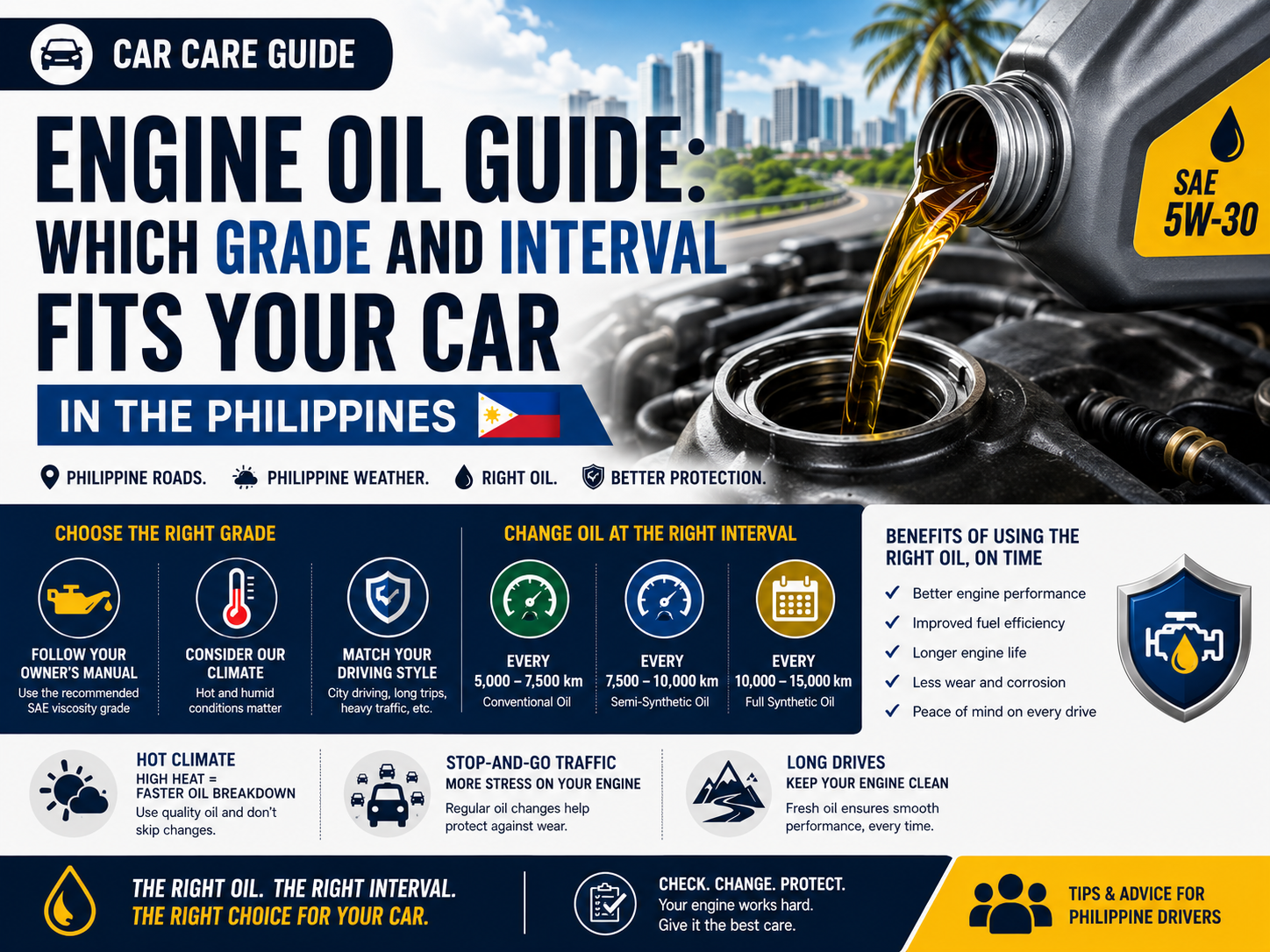
The Philippines’ hot, humid climate puts extra stress on engine oil, making the right viscosity and change interval essential to avoid premature wear and costly repairs. With over 12.4 million registered vehicles nationwide (LTO 2023 data) and 80% operating in severe conditions like Metro Manila traffic, choosing the right oil isn’t just maintenance—it’s critical for engine longevity and fuel efficiency in our tropical environment.
SAE numbers like 5W‑30 or 10W‑40 show how oil flows at low and high temperatures. In our tropical setting (average 28°C year-round, 80% humidity), the high‑temperature number matters most because heat thins the oil faster than in temperate climates.
| Oil Grade | Best For | Philippine Driving Conditions | Fuel Economy Impact |
|---|---|---|---|
| 0W‑20 | Newer turbocharged/hybrid vehicles (2018+) | Excellent for city commutes, reduces wear in stop‑and‑go traffic | Best – up to 5% better fuel economy vs 5W‑30 |
| 5W‑30 | Most Filipino vehicles (Toyota Vios/Honda City 2015‑2023) | Ideal balance for mixed city/highway driving | Good – standard for Philippine OEM recommendations |
| 10W‑30 | Older vehicles (pre‑2015), pickup trucks, SUVs | Suitable for provincial driving with less traffic congestion | Fair – may reduce fuel economy by 2‑3% in hot conditions |
| 10W‑40 | Avoid in modern post‑2010 engines | Only for specific older models or diesel engines as per OEM | Poor – can increase engine wear by 15‑20% in tropical heat |
Source: Philippine Oil Marketers Association (POMA) 2023 Vehicle Lubrication Study
Find the correct viscosity grade for your vehicle in our engine oil selection.
Only 32% of Filipino drivers know their manufacturer’s oil requirement (PASMA 2023 survey), leading to costly mistakes. Ensure you\’re using the correct specification by browsing our engine oil range. In our market, OEM specs often vary by vehicle trim and year due to different engine calibrations for ASEAN vs. global markets.
| Brand | Popular Models | Recommended Viscosity | Required Specs | Where to Find in Manual |
|---|---|---|---|---|
| Toyota | Vios, Yaris, Innova, Hilux | 0W‑20 (2020+), 5W‑30 (2015‑2019) | API SN Plus, ILSAC GF‑5 | Section 5‑02: “Lubrication System” |
| Honda | City, Jazz, BR-V, CR-V | 0W‑20 (2018+), 5W‑30 (pre‑2018) | API SN, ACEA C3 | Page 4‑12: “Engine Oil Recommendation” |
| Mitsubishi | L300, Adventure, Mirage, Xpander | 5W‑30 (most models), 0W‑20 (Xpander HEV) | API SM, JASO MA2 | Chapter 6: “Maintenance Schedule” |
| Ford | Ranger, Everest, EcoSport | 5W‑30 (diesel/gasoline) | WSS‑M2C913‑D, ACEA C2 | Page 7‑05: “Fluid Specifications”|
| Hyundai/Kia | Accent, Rio, Stonic, Sportage | 5W‑20 or 5W‑30 | API SN Plus, ILSAC GF‑5 | Section 3‑03: “Engine Oil” |
Stop‑and‑go traffic (average speeds <15 kph in EDSA), short trips (<8 km), dusty provincial roads, and constant idling accelerate oil breakdown—up to 40% faster than highway driving in our climate (UP Mechanical Engineering Lab 2022 study).
If you check 3+ boxes, follow severe service intervals.
| Factor | Conventional Oil | Synthetic Blend | Full Synthetic |
|---|---|---|---|
| Price per liter (PHP) | ₱180‑250 | ₱280‑380 | ₱400‑550 |
| Change Interval (Severe Conditions) | 3,000‑4,000 km | 5,000‑6,000 km | 7,000‑10,000 km |
| Annual Cost (15,000 km/year) | ₱6,750‑9,375 | ₱7,000‑9,500 | ₱6,000‑8,250 |
| Engine Protection in Heat | Basic – degrades 30% faster at 100°C | Good – maintains viscosity 20% longer | Excellent – maintains viscosity 40% longer |
| Fuel Economy Benefit | Baseline | +1‑2% | +2‑4% |
| Best For Philippine Drivers | Avoid – false economy | Budget‑conscious owners of older vehicles | Most drivers – better long‑term value despite higher upfront cost |
Note: Annual cost assumes 4L oil change + labor. Full synthetic often wins on total cost of ownership in Philippine conditions.
Explore our full range of engine oils to find the best fit for your vehicle and driving habits.
Start with OEM mileage (often 10,000 km for synthetics) then adjust for Philippine conditions:
Keep your engine protected with quality oils from our engine oil collection.
In our heat and humidity, oil degradation shows up faster. Watch for these locally relevant signs:
Pro Tip: Check oil every 500 km or weekly if you drive in severe conditions – the dipstick tells the real story.
Finding reliable service is as important as choosing the right oil. Here are verified recommendations:
Always verify that shops use the correct oil for your specific vehicle – bring your owner’s manual to confirm.
Choosing oil in the Philippines isn’t about following generic advice—it’s about matching OEM guidance to our unique heat, traffic, and road conditions. The proper grade and change schedule, adjusted for Philippine severe service, can extend engine life by 20‑30%, improve fuel economy by 2‑4%, and help you avoid expensive repairs that are all too common in our climate.
Remember: In the Philippines, preventive maintenance saves. A ₱1,500 oil change today can prevent a ₱150,000 engine rebuild tomorrow.
Almost never. Only specific older models (pre‑2010) or diesel engines may require it. Using 10W‑40 in a modern post‑2010 gasoline engine can increase wear by 15‑20% in our heat and reduce fuel economy. Always check your OEM spec—most Philippine‑market Toyotas, Hondas, and Mitsubishis from 2015 onward require 5W‑30 or 0W‑20.
At least every 500 km or weekly if you drive in severe conditions (Metro Manila traffic, frequent short trips, dusty roads). In our roads). The dipstick is your best early‑warning system—check when the engine is cool and on level ground.
Yes for most local driving. While full synthetic costs 40‑60% more per liter, it lasts 30‑60% longer in severe conditions, often lowering your annual oil cost. It also provides better heat resistance, keeps engine cleaner (reducing sludge by up to 40%), and can improve fuel economy by 2‑4%—saving you money at the pump in our expensive fuel market.
Severe service in the Philippines includes: trips under 8 km (common for school/runs/market trips), average speeds below 20 kph (EDSA, C5, Quezon Avenue), dusty provincial roads, coastal/salt air exposure, frequent idling (>15 minutes daily in traffic jams), and regularly carrying heavy loads (>50% vehicle capacity for pasalubong business, construction, or farming). If you experience 3+ of these, follow severe service intervals.
Yes, but do it at an oil change interval and ensure the new oil meets or exceeds the OEM spec for your specific Philippine‑market vehicle model year. Many Filipino drivers make the switch at 40,000–60,000 km when they notice conventional oil breaking down too fast in the heat. Always flush the system if switching from conventional to full synthetic in high‑mileage vehicles to prevent dislodging sludge.
While global brands (Shell Helix, Petron Ultron, Caltex Havoline, Mobil 1) dominate the Philippine market, look for those with “Philippine Formula” or “Tropical Blend” labels—these often have adjusted additive packages for our heat and humidity. Local distributors like Pilipinas Shell, Petron Corporation, and Chevron Philippines formulate specific blends for ASEAN conditions. Always verify the API/ACEA specs match your OEM requirements regardless of brand.
Since 2012, KG Car PH has been the go-to for affordable car parts in the Philippines. We make it easy to find the right fit and offer same-day delivery nationwide—so you get quality parts fast, without spending more.
SOCIAL MEDIA
TOP CATEGORIES
QUICK LINKS
HELP
support@kgcar.ph
© 2026 KGCAR.PH
Since 2012, KG Car PH has been the go-to for affordable car parts in the Philippines. We make it easy to find the right fit and offer same-day delivery nationwide.
Enter your email or mobile so we can follow up with answers, quotes & deals.