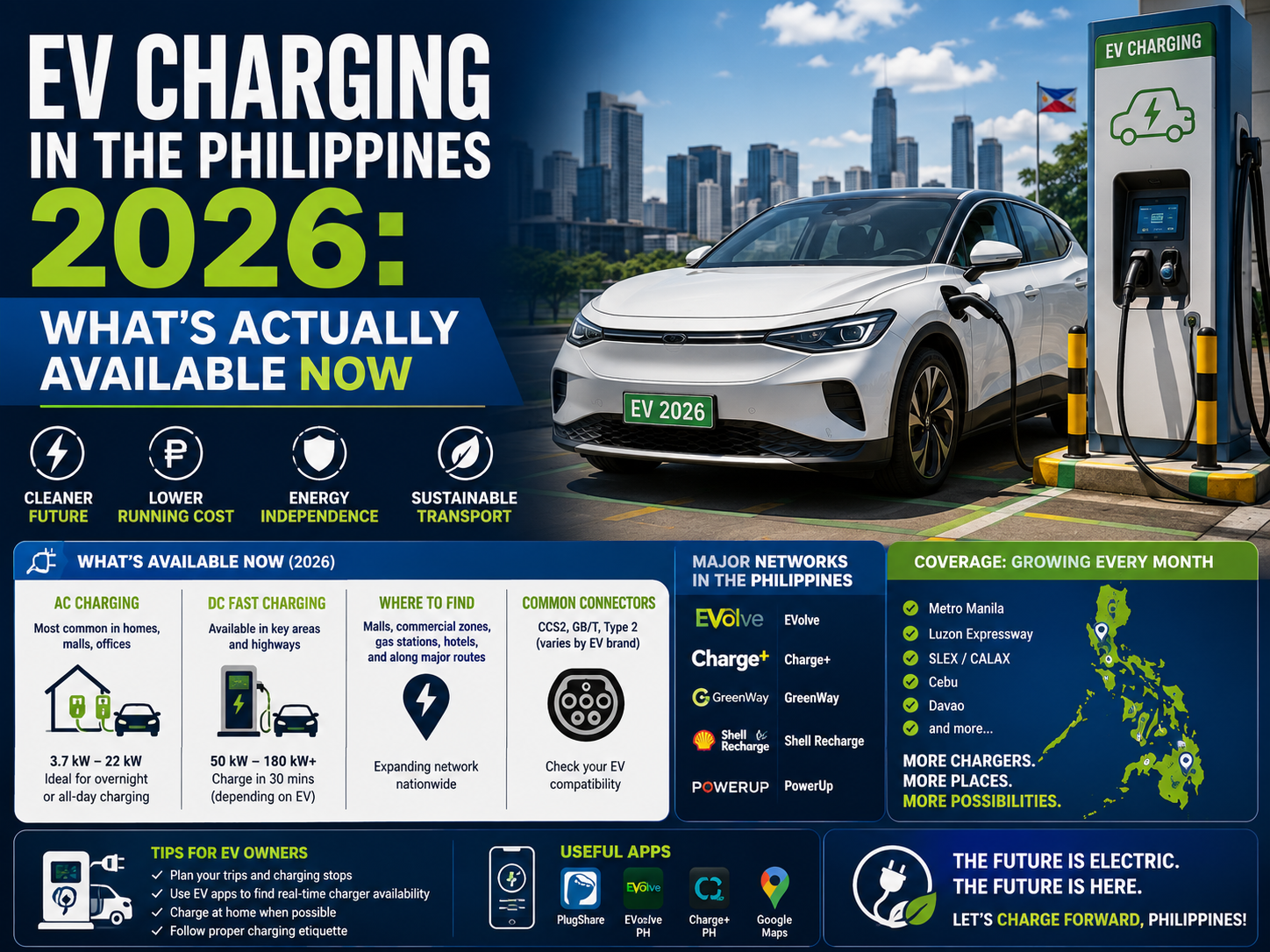
The electric vehicle revolution is gaining momentum in the Philippines, but one critical question remains for potential EV buyers: What charging infrastructure is actually available right now in 2026? As more Filipinos consider making the switch to electric vehicles to save on fuel costs and reduce their environmental impact, understanding the current state of EV charging infrastructure is crucial for making an informed decision.
The Current State of EV Charging in the Philippines (2026)
As of mid-2026, the Philippines has made significant strides in developing its EV charging infrastructure, though distribution remains uneven across the archipelago. Major progress has been concentrated in key metropolitan areas and along major highways, with gradual expansion to secondary cities and tourist destinations.
The Electric Vehicle Association of the Philippines (EVAP) reports that there are now approximately 2,800 public charging points nationwide, up from just 850 in 2023. This represents a 229% increase in just three years, driven by both government initiatives and private sector investment.
Types of EV Chargers Available in the Philippines
Understanding the different charging levels is essential for EV owners:
Level 1 Charging (Slow Charging)
- Uses standard 220V household outlet
- Typical charging speed: 8-12 hours for full charge
- Best for overnight home charging
- Most accessible option, requires no special installation
- Commonly used with portable charging cables that come with most EVs
Level 2 Charging (Medium Charging)
- Requires dedicated 220V circuit and EVSE (Electric Vehicle Supply Equipment)
- Typical charging speed: 4-8 hours for full charge
- Ideal for home, workplace, and public destination charging
- Most common type of public charging station in malls, offices, and hotels
- Power output typically ranges from 3.3 kW to 22 kW
Level 3 Charging (DC Fast Charging)
- Uses direct current for rapid charging
- Typical charging speed: 80% charge in 30-60 minutes
- Found along major highways and in strategic urban locations
- Power output ranges from 50 kW to 350 kW
- Essential for long-distance travel and quick top-ups
Major EV Charging Networks and Providers
Several companies and organizations operate EV charging networks across the Philippines:
1. Meralco eVolt
- The most extensive network with over 800 charging points nationwide
- Strong presence in Metro Manila, CALABARZON, and Central Luzon
- Offers both Level 2 and DC Fast Charging options
- Mobile app for locating chargers, checking availability, and payment
- Partnerships with malls like SM, Ayala Malls, and Robinsons
2. Shell Recharge
- Leveraging existing Shell fuel station network
- Over 300 charging points at select Shell stations
- Focus on DC Fast Charging along major highways (NLEX, SCTEX, TPLEX)
- Convenient for long-distance travel between cities
3. Charge+ (formerly Charge+)
- Rapidly growing independent network
- Strong presence in university districts and business parks
- Offers competitive pricing and membership discounts
- Innovative features like reservation system and real-time availability
4. EVAP Public Charging Initiative
- Collaborative effort between EVAP, LGUs, and private partners
- Focus on municipal buildings, public markets, and tourist areas
- Often offers free or subsidized charging to encourage adoption
- Particularly strong in Visayas and Mindanao regions
- Level 2 AC Charging: ₱15-25 per kWh
- DC Fast Charging: ₱25-40 per kWh
- Typical cost to charge a 60kWh EV battery:
- Level 2: ₱900-1,500 for full charge
- DC Fast: ₱1,500-2,400 for 80% charge
- RFID cards/tags issued by charging networks
- Mobile apps (most common method)
- Contactless credit/debit cards at select locations
- QR code scanning for one-time users
- Subscription plans offering discounted rates
- Level 1 Portable Chargers (included with most EVs): ₱8,000-15,000
- Level 2 Wall-mounted Chargers: ₱25,000-60,000 (including installation)
- Smart Chargers with WiFi/App control: ₱40,000-80,000
- Licensed electrician assessment of home electrical capacity
- Possible need for panel upgrade if home is older
- Permit requirements vary by LGU (mostly straightforward in Metro Manila)
- Typical installation time: 4-8 hours for Level 2 charger
- Excise tax exemption for EVs (Republic Act 11697)
- Special vehicle plates with color coding for easy identification
- Exemption from number coding schemes in Metro Manila and other cities
- Preferred parking in many malls and government buildings
- Lower registration fees compared to conventional vehicles
- DOE’s National Comprehensive EV Charging Program
- Grants and subsidies for LGUs to install public chargers
- Streamlined permitting process for charging station installation
- Building code amendments requiring EV-ready parking in new developments
- Metro Manila: Highest density of chargers, particularly in Bonifacio Global City, Makati, Ortigas, and Quezon City
- Central Luzon: Good coverage along NLEX/SCTEX corridors and in Clark Freeport Zone
- CALABARZON: Strong presence in Laguna, Batangas, and Cavite industrial areas
- Bicol Region: Growing network focused on tourism areas
- Metro Cebu: Good urban coverage, expanding to Mactan and northern towns
- Iloilo City: Moderate coverage with focus on downtown and business districts
- Bacolod: Limited but growing network
- Tourist destinations (Boracay, Bohol, Panglao): Increasing availability
- Davao City: Best coverage in Mindanao, particularly in downtown and Bajada district
- Cagayan de Oro: Developing network focused on commercial areas
- General Santos: Limited but growing availability
- Other cities: Minimal infrastructure, mostly reliant on home charging
- Uneven geographic distribution favoring Luzon
- Limited options in rural areas and smaller provinces
- Charging deserts between major cities on some routes
- Reliability issues with some public chargers (maintenance concerns)
- Lack of standardization in connector types (though Type 2 AC and CCS2 DC are becoming dominant)
- Grid capacity concerns in older neighborhoods
- Need for better integration with renewable energy sources
- Limited availability of ultra-fast chargers (150kW+)
- Multiple apps and RFID systems needed for different networks
- Inconsistent pricing structures between providers
- Limited customer support for troubleshooting
- Need for better real-time availability information
- Interoperability initiatives to allow single payment method across networks
- Expansion of DC Fast Charging corridors along major highways
- Integration with renewable energy (solar-powered charging stations)
- Increased focus on two-wheel and three-wheel EV charging (trikes, e-jeeps)
- Vehicle-to-grid (V2G) pilot programs
- DOE target: 10,000 public charging points by 2030
- mandate for 5% EV penetration in new vehicle sales by 2028
- Plans for electric jeepney and tricycle conversion programs with associated charging infrastructure
- Daily commute length and pattern
- Availability of charging at work or regular destinations
- Access to reliable public charging along your regular routes
- Calculate your current monthly fuel cost
- Estimate electricity cost for home charging (typically 1/4 to 1/3 of gasoline cost)
- Factor in potential savings from maintenance (EVs have fewer moving parts)
- Consider time savings from not visiting gas stations
- Don’t occupy charging spots longer than necessary
- Move your vehicle promptly after charging is complete
- Report malfunctioning chargers to the network operator
- Consider charging during off-peak hours when rates may be lower
Charging Costs and Payment Methods
Understanding the cost structure helps EV owners budget effectively:
Public Charging Rates (2026 Average)
Payment Methods Available
Home Charging Installation Options
For EV owners with private parking, home charging offers the greatest convenience and lowest cost per kilometer:
Types of Home Chargers
Installation Requirements
Government Incentives and Policies Supporting EV Adoption
The Philippine government has implemented several measures to encourage EV adoption:
Existing Incentives (as of 2026)
Charging Infrastructure Support
Regional Availability Breakdown
EV charging availability varies significantly by region:
Luzon (Best Coverage)
Visayas (Developing)
Mindanao (Emerging)
Challenges and Areas for Improvement
Infrastructure Gaps
Technical Challenges
User Experience Issues
The Future of EV Charging in the Philippines
Planned Improvements
Government Targets
Practical Advice for Prospective EV Owners
Assess Your Charging Needs
Cost Comparison Tips
Charging Etiquette Best Practices
Conclusion
The EV charging landscape in the Philippines has evolved significantly by 2026, making electric vehicle ownership increasingly practical for many Filipinos, particularly those in urban areas with predictable driving patterns. While challenges remain in terms of geographic coverage and standardization, the core infrastructure needed for daily EV use is now in place in major population centers.
For potential EV buyers, the key is to assess your specific needs against the availability of charging options in your regular travel patterns. If you have access to home charging and primarily drive within metro areas with good charging infrastructure, an EV can be a practical and cost-effective choice today. Those who frequently travel long distances or live in areas with limited charging access may want to wait for further infrastructure expansion or consider hybrid options as a transitional solution.
As the Philippines continues to invest in sustainable transportation and renewable energy, the EV charging network will undoubtedly expand and improve, making electric mobility an increasingly viable option for Filipinos nationwide.
For all your EV-related automotive parts and accessories needs, visit KG CAR PH for expert advice and quality products.
Frequently Asked Questions
Is there enough EV charging infrastructure in the Philippines for daily use?
For daily commuting in major metropolitan areas (Metro Manila, Cebu, Davao) with access to home or workplace charging, yes, the infrastructure is generally sufficient. However, for those relying solely on public charging or living outside major cities, availability may still be limited. The key is matching your vehicle choice to your specific charging access patterns.
How long does it take to charge an electric vehicle in the Philippines?
Charging time depends on the charger type and your vehicle’s battery capacity: Level 1 (home outlet): 8-12 hours for full charge; Level 2 (public/workplace): 4-8 hours; DC Fast Charging: 30-60 minutes for 80% charge. Most EV owners find overnight home charging or topping up while at work/school meets their daily needs.
Are EV charging stations safe to use in the Philippines?
Yes, reputable charging stations in the Philippines adhere to international safety standards. However, as with any electrical equipment, it’s important to: use only certified charging equipment, follow manufacturer instructions, report any damaged equipment to the operator, and avoid charging during severe weather when possible. Most networks have regular maintenance schedules and customer support for safety concerns.
What is the cost difference between charging an EV and fueling a gasoline vehicle in the Philippines?
On average, charging an EV costs about 70-80% less than fueling a comparable gasoline vehicle. Based on 2026 average electricity rates of ₱15-25/kWh for Level 2 charging and gasoline prices of ₱60-70/liter, an EV typically costs ₱1.50-2.50 per kilometer to operate, compared to ₱5.00-8.00 per kilometer for a gasoline vehicle. This translates to annual fuel savings of ₱30,000-50,000+ for the average Filipino driver.
Can I install an EV charger at my home or condominium?
For single-family homes with dedicated parking, home charger installation is generally straightforward with a licensed electrician. For condominiums and townhouses, you’ll need to: check your building’s administration policies regarding electrical modifications, obtain necessary approvals from the homeowners’ association, ensure adequate electrical capacity in your unit or common areas, and consider shared charging solutions if individual installation isn’t feasible. Many newer developments are now being built EV-ready with conduit and electrical capacity pre-installed.