


Since 2012 – Quality Wholesale Parts, Nationwide! Connect With Us Now
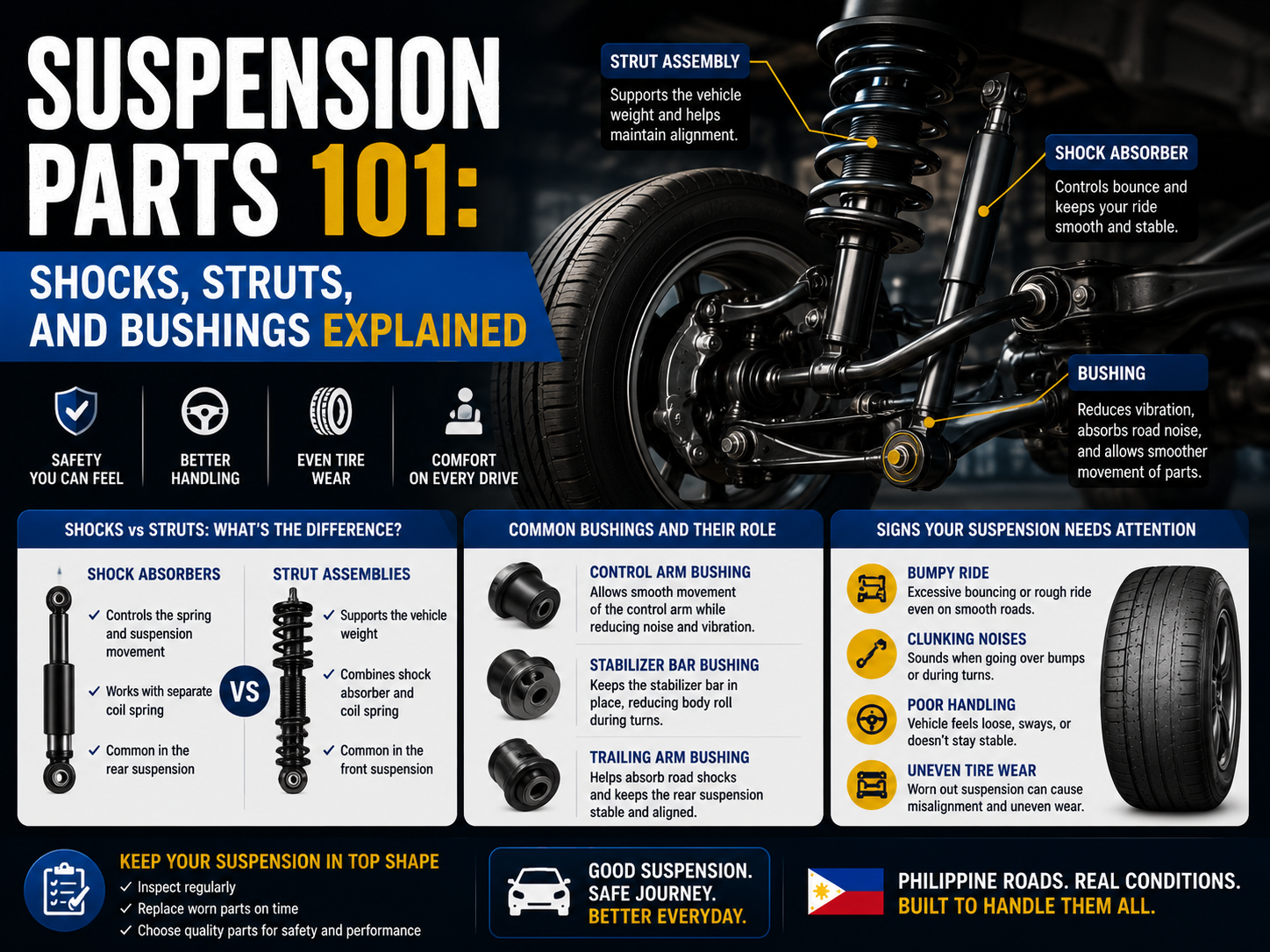
Is your car bouncing like a jeepney on rough roads? Do you hear unusual creaking or squeaking noises when going over bumps? Those symptoms might not just be “normal Philippine road sounds” – they could be your suspension system crying for attention. With over 12.4 million registered vehicles nationwide navigating everything from Metro Manila’s pothole-ridden streets to flood-prone provincial roads, your car’s suspension works overtime to keep you safe and comfortable. Understanding the difference between shocks, struts, and bushings isn’t just for mechanics – it’s essential knowledge for every Filipino driver who wants to maintain ride quality, ensure safety, and avoid costly repairs down the road.
Your vehicle’s suspension system is more than just springs – it’s a complex network of components working together to absorb road impacts, maintain tire contact with the road, and provide stable handling. Think of it as the “shoes” of your car – just as you need good footwear to walk comfortably on uneven terrain, your car needs proper suspension components to navigate Philippine roads safely.
The three main components we’ll focus on are:
While both shocks and struts dampen vibrations, they serve different structural roles:
| Component | Function | Structural Role | Common Applications |
|---|---|---|---|
| Shock Absorber | Controls spring oscillation, dampens vibrations | Separate component, connects suspension to frame | Many trucks, SUVs, rear suspensions |
| Strut | Combines shock damping with structural support | Integral part of suspension, replaces upper control arm | Most front-wheel-drive cars, modern suspensions |
The unique challenges of Philippine driving conditions mean your suspension components face constant stress that drivers in temperate climates rarely experience:
Metro Manila alone has thousands of potholes that can deliver sudden, violent impacts to your suspension. As reported by Philkotse, these sudden hits can damage crucial parts like tie rods, steering rack, shocks, struts, and ball joints. Each deep pothole impact is like a mini-accident for your suspension system.
During typhoon season, flooded roads submerged suspension components in water mixed with road salts, oils, and debris. This accelerates corrosion, particularly on shock absorber pistons and strut housings, leading to premature failure and fluid leaks.
Unpaved or poorly maintained provincial roads subject suspension to constant vibration and abrasive dust. Bushings dry out and crack faster, while shock absorbers work overtime to control excessive wheel movement on washboard surfaces.
Filipino drivers should be particularly vigilant about these suspension warning signs, given our challenging road conditions:
One of the simplest ways to check your shock absorbers or struts:
As noted by Philkotse auto maintenance experts: “If there are 3 or more bounces, it means your suspension (especially the shock absorber) needs replacing.”
Your ears are valuable diagnostic tools. Pay attention to:
“If there comes a creaking or squeaking sound, there may by problems with the shocks, bushings or the spring,” according to suspension specialists.
Regular visual inspections can catch problems early:
While shocks and struts get most of the attention, bushings are silent heroes that significantly affect ride quality and handling:
Bushings are located at virtually every suspension joint where metal parts connect. They:
In Philippine conditions, bushings face unique challenges:
Failed bushings can cause:
Given our challenging road conditions, Filipino drivers should follow a more aggressive suspension maintenance schedule than what’s typically recommended in owner’s manuals:
Knowing when to replace these components can save you from more expensive repairs and unsafe driving conditions:
Replace when you observe:
Replace bushings when you notice:
Understanding typical costs helps Filipino drivers budget for suspension maintenance:
| Service Type | Average Cost (PHP) | Time Required | Best For |
|---|---|---|---|
| Shock absorber replacement (pair) | ₱3,000 – 8,000 | 1-2 hours | Worn shocks affecting ride and handling |
| Strut replacement (pair) | ₱5,000 – 12,000 | 2-3 hours | Worn struts (includes spring and mount replacement) |
| Suspension bushing replacement | ₱1,500 – 4,000 per bushing | 1-3 hours (depending on location) | Worn bushings causing noise or handling issues |
| Complete suspension refresh (shocks/struts + bushings) | ₱15,000 – 35,000+ | 3-6 hours | High-mileage vehicles or those used in severe conditions |
| Wheel alignment | ₱800 – 1,500 | 30-60 minutes | After suspension work or major pothole impact |
Not all replacement parts are created equal. For Philippine road conditions, consider:
For daily drivers in Philippine conditions, quality rubber bushings from reputable brands often provide the best balance of comfort and longevity.
Suspension work requires specialized knowledge and tools. When seeking service in the Philippines:
While you can’t avoid all road hazards, these practices can help prolong your suspension components’ life:
Your vehicle’s suspension system is its crucial link to the road – affecting everything from ride comfort and handling to braking efficiency and tire wear. In the challenging driving conditions of the Philippines, where potholes, flood waters, and rough provincial roads are common realities, understanding and maintaining your shocks, struts, and bushings isn’t just about comfort – it’s about safety and financial prudence.
By learning to recognize the warning signs of worn suspension components – from the simple bounce test to listening for telltale noises – Filipino drivers can address issues before they lead to safety hazards or more expensive repairs. Regular inspections, timely replacements, and choosing quality parts suited to our local conditions will keep your suspension performing optimally kilometer after challenging kilometer.
Remember: A well-maintained suspension doesn’t just make your ride more comfortable – it keeps your tires firmly planted on the road, your steering responsive, and your driving safe. In the Philippines’ unique driving environment, that peace of mind is worth every peso invested in proper suspension care.
For all your suspension-related automotive parts and accessories needs, visit KG CAR PH for expert advice and quality products.
While manufacturer guidelines often suggest 80,000-100,000 km, Philippine road conditions typically warrant replacement every 50,000-70,000 km for drivers in Metro Manila or those frequently using provincial roads. Regular bounce tests and visual inspections are better indicators than mileage alone.
It’s not recommended. Worn shocks/struts compromise handling, increase stopping distances, cause uneven tire wear, and put additional stress on other suspension components. In emergency situations, reduced control could lead to accidents. Address worn shocks/struts promptly for safety.
For daily drivers facing challenging Philippine roads, quality aftermarket shocks from reputable brands (KYB, Monroe, Tokico) often provide better value than OEM replacements. They frequently offer improved damping characteristics, better heat resistance, and enhanced durability compared to stock units, making them well worth the investment for improved ride quality and longevity.
Many modern vehicles use non-serviceable bushings that are pressed into the control arm and cannot be replaced separately. In these cases, the entire control arm assembly must be replaced when bushings wear out. Some older or specific models still offer serviceable bushings that can be pressed out and replaced individually, which is more cost-effective when only the bushings are worn.
Signs you need alignment after a pothole impact include: steering wheel pulling to one side, uneven or rapid tire wear, steering wheel vibration at certain speeds, or visible damage to suspension components. It’s wise to get an alignment check after any significant pothole impact, especially if you notice changes in handling or tire wear patterns.
Since 2012, KG Car PH has been the go-to for affordable car parts in the Philippines. We make it easy to find the right fit and offer same-day delivery nationwide—so you get quality parts fast, without spending more.
SOCIAL MEDIA
TOP CATEGORIES
QUICK LINKS
HELP
support@kgcar.ph
© 2026 KGCAR.PH
Since 2012, KG Car PH has been the go-to for affordable car parts in the Philippines. We make it easy to find the right fit and offer same-day delivery nationwide.
Enter your email or mobile so we can follow up with answers, quotes & deals.